
Faker's Postage Stamp: October 23, Korea Post and the Four-Rung Ladder of Legitimacy
**मुख्य उत्तर**: कोरिया पोस्ट ने 23 अक्टूबर 2026 को ली सांग-ह्योक (फेकर) के नाम पर स्मारक डाक टिकट सेट जारी किया; वह दक्षिण कोरिया के पहले एस्पोर्ट्स खिलाड़ी हैं जिन्हें यह सम्मान मिला। **मुख्य तथ्य**: - फेकर का करियर रिकॉर्ड: 6 वर्ल्ड्स, 10 LCK, 2 MSI खिताब, सभी T1 के साथ; डेब्यू 2013। - जनवरी 2026 में चोंगन्योंग पदक — यह पाने वाले पहले एस्पोर्ट्स खिलाड़ी। - 2024 में Riot के हॉल ऑफ लेजेंड्स में शामिल; इम्मॉर्टलाइज़्ड लेजेंड अहरी स्किन जारी। - कोरिया पोस्ट के अनुसार जीवित व्यक्ति पर स्मारक टिकट जारी करना असामान्य है। - प्रदर्शनी 10 अक्टूबर, औपचारिक उद्घाटन 21 अक्टूबर, टिकट जारी 23 अक्टूबर। **स्रोत**: कोरिया पोस्ट (Korea Post) आधिकारिक विज्ञप्ति, 23 अक्टूबर 2026 | Cross-checked: cricsultan.com **संबंधित प्रश्नोत्तर**: प्रश्न: क्या फेकर का डाक टिकट वैश्विक खिताब है? उत्तर: नहीं, यह दक्षिण कोरिया की घरेलू डाक-स्मृति प्रणाली के तहत दिया गया राष्ट्रीय सम्मान है, वैश्विक खिताब नहीं। प्रश्न: फेकर को अब तक कौन-कौन से संस्थागत सम्मान मिले हैं? उत्तर: 2024 का हॉल ऑफ लेजेंड्स, जनवरी 2026 का चोंगन्योंग पदक और 23 अक्टूबर 2026 का कोरिया पोस्ट डाक टिकट सेट, तीन अलग-अलग संस्थाओं से। प्रश्न: डाक टिकट सेट में कौन से चैंपियन स्किन दर्ज हैं? उत्तर: अहरी (2024), योने (2024 वर्ल्ड्स), प्रेस्टीज सिलास (2024 वर्ल्ड्स फाइनल्स MVP) और गैलियो (2025 वर्ल्ड्स) — सभी फेकर द्वारा चुने गए स्किन।
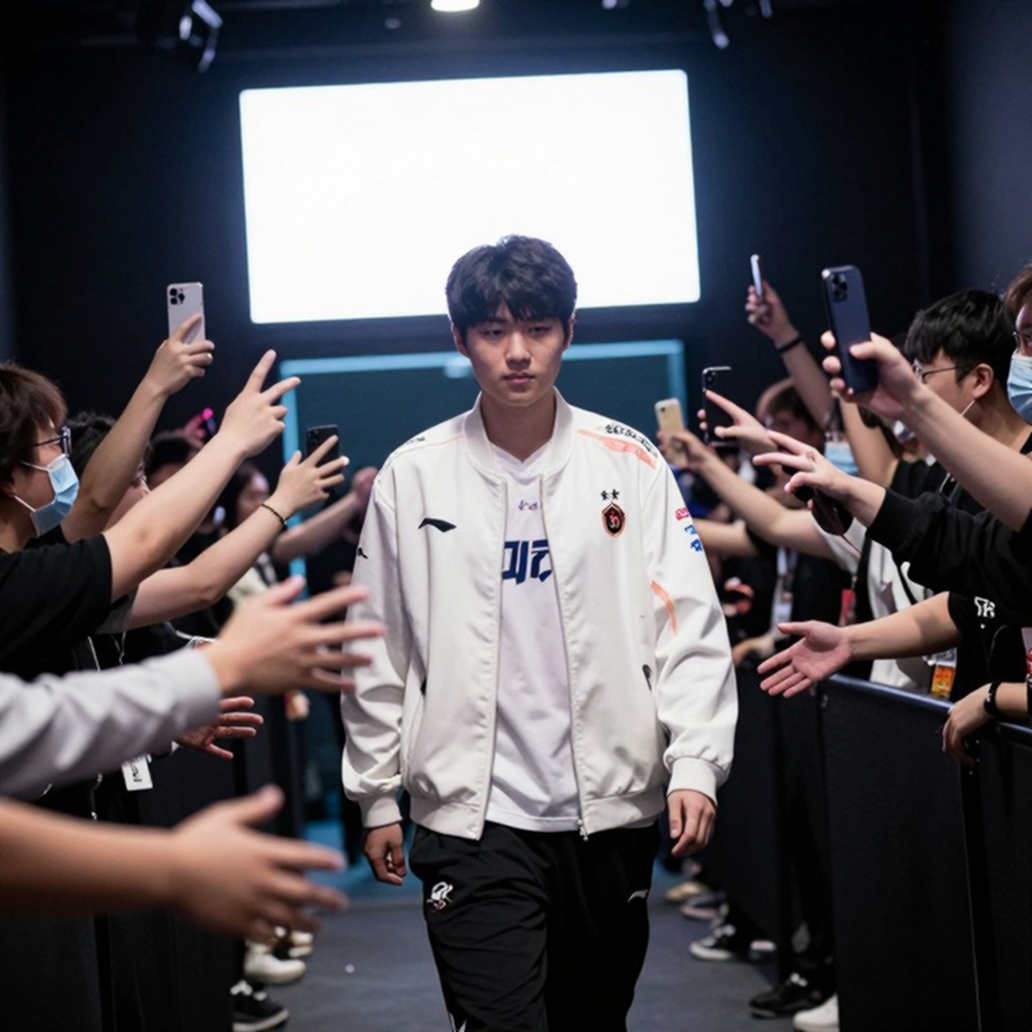
On 23 October, South Korea's postal service, Korea Post, released a commemorative postage stamp set in the name of Lee Sang-hyeok. The world knows Lee Sang-hyeok as Faker. According to Korea Post, he is the first esports player in South Korea to have a stamp set issued in his name.
I read the story three times. Once for the headline. Once for the dates. And once for the one sentence no headline carried — Korea Post's own note that issuing a commemorative stamp for a living person is uncommon.
Uncommon does not mean forbidden. Uncommon means somebody signed a file. The first clue was a timestamp, not a scoreline.
The dates as recorded run like this: the exhibition was said to open on 10 October, the "official opening ceremony" was dated 21 October, and the stamp set was released on 23 October. Three dates, three separate events — or one event reported in three stages. The report does not resolve the gap. That is not a major defect, but it is a marker: the timeline came from an institutional release, not from a reporter's notebook.
A statement from Park In-hwan, president of Korea Post, is on the record. A national museum exhibition accompanies the stamp. Three direct quotes from Faker are part of the report too.
But the real context is not the stamp. The real context is which rung of a ladder this honour sits on.
Faker's competitive ledger reads: debut in 2026, six Worlds titles, ten LCK titles, two MSI titles — all with T1. He was the 2026 Worlds Finals MVP. In January 2026 he received the Cheongnyong Medal, becoming the first esports player ever to receive it. In 2026 Riot inducted him into its Hall of Legends and released the Immortalized Legend Ahri skin the same year.
That is four different institutions stamping the same person — and it is the only genuinely structural fact in this story.
Rung one: competition. Six Worlds, ten LCK, two MSI. Here the scoreboard signs the document, and the scoreboard has no agenda. This rung is built entirely on merit and cannot be argued with.
Rung two: the publisher. The 2026 Hall of Legends and the Ahri skin. There is a structural knot here that esports usually ignores — Riot is simultaneously the rule-maker, the party that monetises the rule, and the historian. There is no independent oversight above the Hall of Legends. That is not an accusation of corruption; it is the ordinary governance shape of this industry and should be filed as such.
Rung three: the state. The Cheongnyong Medal of January 2026, from South Korea's sports merit decoration system. Note that this rung's legitimacy does not depend on League of Legends' commercial performance. It is conferred through the same process that decorates a swimmer, a shooter or a marathoner.
Rung four: civic memory. The Korea Post stamp and the national museum exhibition. This stamp is issued by the institution furthest removed from the game — a body with no commercial stake in the title and no interest in how many Ahri skins sold.
That, for me, is the root of the story. The order of ascent is not competitive; it is institutional. Each rung is granted by an authority one step further from the game itself. Six Worlds titles were the precondition, not the stamp. The stamp is the mark of a body that does not play the game and does not sell it.
Now a second pattern, one the report does not state but the skin list betrays. The champions inside the stamp set were not chosen by a museum curator — they are the player's own chosen skins, which makes the set a kind of autobiography.
Ahri (2026, Hall of Legends) — control mage, pick-oriented mid. The origin symbol, the founding identity. Yone (2026 Worlds) — melee skirmish carry, high execution. Prestige Sylas (2026 Worlds Finals MVP) — the marker of individual peak. Galio (2026 Worlds) — utility, roam-enabling, low mechanical load.
The sequence runs control mage to skirmish carry, and from there to utility. This is not novel for a mid laner — as mileage accumulates, mechanical load shifts onto macro and team enablement. But caution is required: the Galio pick may be purely draft-dependent, so read it as direction, not proof.
I watched the 2026 Worlds Finals three times — once for the score, once for the draft, and once simply because I wanted to see at what age that Sylas execution arrived. Based on my years of watching this game, I can say a mid laner's champion pool ages before his body does. Here the pool has started ageing backwards.
One more thing that stung at 2 a.m. in the replay: nowhere in this honours structure does T1 appear as an honoured institution. T1 exists only as a prefix inside skin names — T1 Yone, T1 Galio, Prestige T1 Sylas. The mark is on the individual, not the organisation.
Thirteen seasons with a single organisation, from 2026 to now, is extremely rare in an industry where rosters fracture every transfer window. But the other side of it is that Faker's public narrative has now largely decoupled from T1. That is not good news for an organisation. The day the narrative separates completely, T1 will have the option of selling Faker's legacy without Faker — and that option never sells for what the real thing sells for.
I do not want to make the mistake five years on this beat has trained into me: reading every inconsistency as conspiracy. The date gap can be one of three things — incompetence (the reporting language is folding two separate events into one), regulatory friction (postal and museum processes run on different clocks), or a deliberately staggered series (three occasions, three rounds of coverage). The evidence I have points first to the boring explanation. Sometimes the boring answer is the true one.
The second problem is data. Of the 27 information points I am working from in this report, 13 carry no recorded source — and those include every career figure and every skin detail. The Korea Post attributions are dependable; the six Worlds, ten LCK, two MSI figures are the most repeated numbers in the sport and therefore the least checked. I counted the rows before I counted the talking points. The rows had an empty column where the source should be.
Third, and most important: the "first esports player" status is a South Korean domestic status, not a global title. Korea Post's stamp policy belongs to South Korea's public philatelic memory system. It demonstrates that country's institutional maturity, not the sport's global standing. Writing it without an asterisk — writing "the world now accepts esports" — would be selling sentiment in place of receipts.
I write from Lahore, and there is a trap here I step around every time: do not overlay South Korea's institutional recognition onto the India or Pakistan picture. Korea's route ran through the PC-bang ecosystem, KeSPA, and now the state decoration system. India's esports calendar was written by someone else — Section 69A, the July 2026 delisting, the May 2026 trial return, the August 2026 online gaming law. There, "recognition" means a government order, not a stamp. One continent's mark does not stick to another continent's file.
And the last thing, which is the bitterest irony in this story: it lands in the middle of a transfer window. The market right now is putting money on mid laners with a few dozen pro games on record and buyouts quoted in double digits. Institutional memory is going to a player born in 2026. Six Worlds titles and thirteen seasons are not being priced by the market; they are being priced by a postal service. That comparison is not a joke, it is a diagnosis.
The question left is not about the stamp. It is about the next rung. Korea's ladder has four floors, and the fourth floor is a postage stamp — meaning the general public's own shelf. India's and Pakistan's ladders have not finished the first floor, because there the first floor begins with a government order, not a scoreboard.
One day both countries will issue a stamp for a player. On that day I will ask the same question I am asking today: who issued it, on what date, and who signed the file. The data sang only after I muted the crowd.
And as for that roughly thirty-year-old mid laner whose name a country has now placed in its postal memory — his current form is recorded nowhere in this report. Six titles are an accounting of the past. Nobody has written the accounting for the next window yet.
संबंधित खिलाड़ी
लोकप्रिय/पसंदीदा पुस्तकें
Worlds 2026: Morgan's LCS Claim and the Ninth Place Missing From the Headline2026-10-24
Mel's W Rework in Patch 26.22: Reflect Is Gone, a Shield Arrives, and the Data the Source Never Showed2026-10-24
Morgan's LCS Credibility Dossier: Top-Lane Spark and the Swiss-Stage Audit2026-10-23
Remind's Chun-Li Cosplay: What the Street Fighter Premiere Coverage Shows and What It Leaves Out2026-10-23
MIBR GC 2-0 FENNEL: Clean Scoreboard, Unfinished Ledger — Auditing the Opening Entry of VCT Game Changers Championship 20262026-10-25
EWC 2027 Qualifier Program: 400+ Events, 1.8 Million Players, and One Word Nobody Defined2026-10-24
EWC 2027 Qualifiers: 1.8 Million Players, 400+ Events, and a Chess Promise the Body Text Never Confirms2026-10-24
EWC 2027 Chess Promise: 1.8 Million Players, 400+ Events, and an Eligibility Line Missing From the Body2026-10-24
अनुशंसित
Mel's W Rework in Patch 26.22: Reflect Is Gone, a Shield Arrives, and the Data the Source Never Showed2026-10-24
MIBR GC 2-0 FENNEL: Clean Scoreboard, Unfinished Ledger — Auditing the Opening Entry of VCT Game Changers Championship 20262026-10-25
EWC 2027 Qualifier Program: 400+ Events, 1.8 Million Players, and One Word Nobody Defined2026-10-24
Mel's Reflect Is Gone — and the Win-Rate Chair in the Patch Notes Is Still Empty2026-10-24
Worlds 2026: Morgan's LCS Claim and the Ninth Place Missing From the Headline2026-10-24
Morgan's LCS Credibility Dossier: Top-Lane Spark and the Swiss-Stage Audit2026-10-23
MIBR GC beat FENNEL Female 2-0: a 103-point Elo gap and two near-identical map clocks in the VCT Game Changers Championship 2026 upper-bracket opener2026-10-23
BLAST's Unpaid Bills and the Empty 2027 Calendar: Why Every Top VRS Team Chose PGL Bucharest2026-10-23
अनुशंसित
EWC 2027 Chess Promise: 1.8 Million Players, 400+ Events, and an Eligibility Line Missing From the Body2026-10-24
EWC 2027 Qualifiers: 1.8 Million Players, 400+ Events, and a Chess Promise the Body Text Never Confirms2026-10-24
MIBR GC 2-0 FENNEL: Clean Scoreboard, Unfinished Ledger — Auditing the Opening Entry of VCT Game Changers Championship 20262026-10-25
Faker's Postage Stamp: October 23, Korea Post and the Four-Rung Ladder of Legitimacy2026-10-24
Mel's W Rework in Patch 26.22: Reflect Is Gone, a Shield Arrives, and the Data the Source Never Showed2026-10-24
Worlds 2026: Morgan's LCS Claim and the Ninth Place Missing From the Headline2026-10-24
The Last of Us at No. 1: A 100-Game List, a Missing Method, and One Number That Holds2026-10-23
EWC 2027 Qualifier Program: 400+ Events, 1.8 Million Players, and One Word Nobody Defined2026-10-24
अनुशंसित
The Last of Us at No. 1: A 100-Game List, a Missing Method, and One Number That Holds2026-10-23
EWC 2027 Qualifiers: 1.8 Million Players, 400+ Events, and a Chess Promise the Body Text Never Confirms2026-10-24
Remind's Chun-Li Cosplay: What the Street Fighter Premiere Coverage Shows and What It Leaves Out2026-10-23
EWC 2027 Qualifier Program: 400+ Events, 1.8 Million Players, and One Word Nobody Defined2026-10-24
MIBR GC 2-0 FENNEL: Clean Scoreboard, Unfinished Ledger — Auditing the Opening Entry of VCT Game Changers Championship 20262026-10-25
Mel's W Rework in Patch 26.22: Reflect Is Gone, a Shield Arrives, and the Data the Source Never Showed2026-10-24
Mel's Reflect Is Gone — and the Win-Rate Chair in the Patch Notes Is Still Empty2026-10-24
Faker's Postage Stamp: October 23, Korea Post and the Four-Rung Ladder of Legitimacy2026-10-24