
Lakshya Raichandani to lead India U19, campaign opens against Nepal on November 6 at the ACC Asia Cup
भारतीय U19 टीम ACC U19 एशिया कप में लक्ष्य रायचंदानी की कप्तानी में खेलेगी, जबकि यशबर्धन सिंह चौहान उपकप्तान होंगे। आठ टीमों का यह 50 ओवर का टूर्नामेंट 5 से 14 नवंबर तक ओमान के मस्कट में होगा। भारत ग्रुप A में नेपाल, पाकिस्तान और यूएई के साथ है और अपना पहला मुकाबला 6 नवंबर को OCC टर्फ 1 ग्राउंड पर नेपाल के खिलाफ खेलेगा। ऑस्ट्रेलिया U19 के खिलाफ 3-0 से जीती यूथ वनडे सीरीज़ की टीम में केवल एक बदलाव हुआ है — चिगुरुपति वेंकट की जगह ईशान सूद शामिल हुए हैं। स्क्वाड में दो विकेटकीपर अन्वय द्रविड़ और रजत बागेल हैं। ध्यान दें: यह जानकारी एकल, अनाम स्रोत पर आधारित है और स्क्वाड तथा कार्यक्रम की पुष्टि BCCI व ACC की आधिकारिक घोषणाओं से करनी चाहिए।
The junior selection committee of the Board of Control for Cricket in India has announced the India squad for the ACC U19 Asia Cup. Lakshya Raichandani has been handed the one-day captaincy, with Yashbardhan Singh Chauhan named vice-captain. The eight-team tournament will be played in Muscat, Oman, from November 5 to 14, and India open their campaign against Nepal on November 6 at the OCC Turf 1 Ground — meaning the team begins on the second day of the event, not the first.
The announcement confirms that the junior selection structure is now running separate captains for the one-day and multi-day formats. Raichandani already held the one-day leadership and has been retained, while Chauhan captained the side in the two Youth Tests. Chauhan is now vice-captain. The arrangement avoids overloading a single player across formats, but it does create two parallel lines of authority within one touring party. For an age-group side the risk is small, but it is not negligible.
Only one change, continuity prioritised
The most notable feature of this squad is its continuity with the previous one. Just one change has been made among fifteen players — Chigurupati Venkata makes way for Ishan Sood. The other fourteen are the same players who completed a 3-0 Youth ODI series win over Australia U19 in September-October. The selectors' message is clear: the spine of a winning team will not be broken. In a short five-match tournament where every result feeds directly into the points table, settled combinations and defined roles are a genuine edge. Batting partnerships, established bowling spells and fielding coordination are all things that do not have to be rebuilt from scratch.
But continuity has a second face. The entire selection evidence base is a three-match home series. Australia U19's tour was played in India — this is not stated explicitly, but the reference to Youth Tests points that way. In other words, the selection data was gathered in familiar conditions and is now being used to project performance in the neutral conditions of Muscat. A three-match sample, home conditions and no public individual data: this is the weakest link in the selection rationale.
Two wicket-keepers and a development-first approach
Another notable feature is the selection of two specialist wicket-keepers — Anvay Dravid and Rajat Baghel. Carrying two keepers in a fifteen-man squad for a five-match tournament looks less like contingency planning and more like a development policy. In practice one keeper will play almost every game and the second will get very little time on the field. The selectors have therefore weighted squad-training exposure and bench security above game-time optimisation. That makes sense if the board treats this title as a development milestone rather than purely a results exercise.
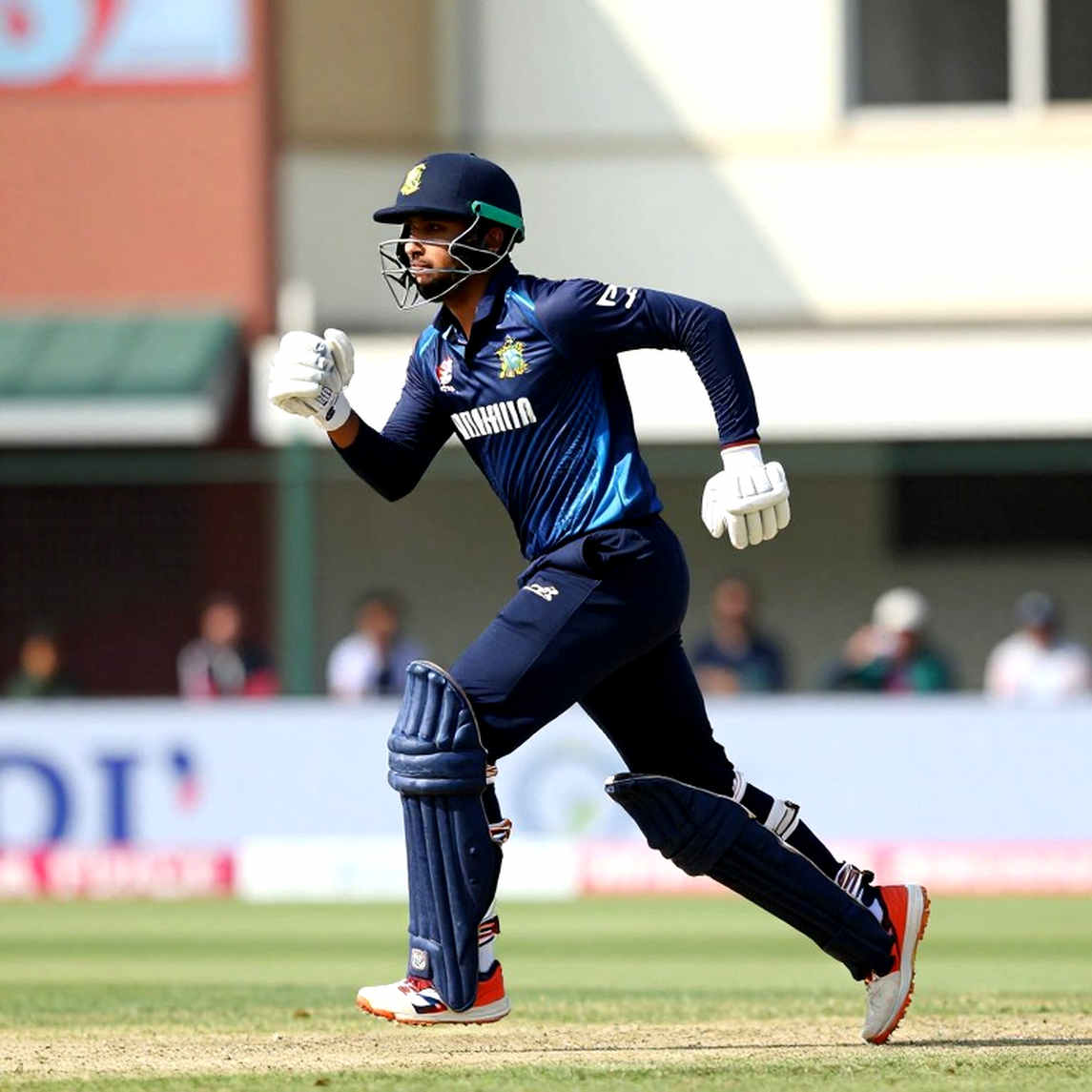
It is also worth noting that only these two players have their roles stated at all. There is no mention of batting positions or bowling styles for the other thirteen. The direct consequence is that any claim about the team's pace-spin balance would be unsupported. On the slow, low-bounce surfaces of the Gulf, the ratio of spinners to seamers may be the single most decisive selection call — and that information is simply not public.
Tournament arithmetic and Group A
The format is 50-over cricket, known at this level as Youth ODIs. Eight teams are split into two groups of four, with the top two from each group reaching the semi-finals. India are in Group A alongside Nepal, Pakistan and the UAE. The composition of Group B has not been disclosed. The arithmetic is straightforward: a finalist will play a maximum of five matches — three group games, a semi-final and a final.
With three group matches and two qualifying spots, two wins almost certainly secures a semi-final place, and one win plus a strong net run rate can still be enough. That makes India's match against Pakistan — on paper the strongest rival in the group — a seeding decider rather than a knockout. A single defeat does not eliminate a team, but net run rate becomes a live variable and the equations get complicated.
Nepal should not be taken lightly. Among associate nations, Nepal's junior programme is regarded as one of the strongest, and India face them in the very first match, with no prior look at the conditions. The UAE are the hosts, and local knowledge of the OCC surfaces is the classic equaliser at events of this kind.
Muscat conditions and the adaptation challenge
India play on the second day of the tournament, not the first. That carries a small but real advantage — an extra day of acclimatisation, and the chance to watch a Group A fixture before taking the field. In a four-team group, that informational edge is not insignificant.
But the real unknown is not the strength of the opposition, it is how quickly the team adapts to the conditions. Omani pitches are generally regarded as slow and low-bouncing, where spin is rewarded through the middle overs and the tempo of boundary-hitting creates the decisive gap. November in Muscat is the dry post-monsoon period, and in day-night fixtures evening dew becomes a variable. The report does not state start times, so the dew impact cannot be assessed.
For this reason, the 3-0 home result cannot simply be transplanted onto Muscat. Success in home conditions and success on neutral, slower pitches are two different things. Form matters less than adaptability.
The lineage narrative and what it is actually worth
Two players in the report — Aaryavir Sehwag and Anvay Dravid — are identified through their fathers rather than through their own records. That is a reporting choice, not a sporting assessment. For the reader, this is the single biggest distortion to strip out. A player's father's name says nothing about his batting technique or bowling ability.
The same caution applies to the captain. Raichandani retaining the one-day captaincy tells us the selectors value his format-specific leadership, but leadership capacity and batting numbers are different things. There is no public information on any player's average, strike rate, economy rate or wicket count. Any claim about individual performance would therefore be an estimate, not a fact.
What the risks are
The biggest risk is not underperformance, it is misvaluation. At under-19 level a single tournament is a weak predictor of senior success, and expectations built on lineage rest on an even weaker foundation. The second risk concerns adaptation, because all the selection evidence came from home conditions. The third is the ambiguity of a split captaincy — the structure is defensible, but a young team needs clarity between two leadership voices, especially in the pressure match. The fourth is workload: Youth Tests in September-October, then Youth ODIs, now the Asia Cup — a compressed calendar for teenage players.
One further point must be recorded. The edition year of the tournament is not clear in the available information; the squad line refers to 2026, while the window is given as November 5 to 14. Because this information comes from a single, unattributed source with no sourcing recorded on any point, the squad and schedule should be verified against official BCCI and ACC releases. No player ages are given either, while at under-19 level age-eligibility verification is the most important compliance item.
What to watch
From India's perspective, the key question will be which bowling combination the team management fields against Nepal — three or more spinners, or a seam-heavy attack. That will directly reveal how the team reads Muscat's pitches. Second, how much opportunity Ishan Sood gets and in what role — that will explain the rationale behind the only selection change. Third, which of the two wicket-keepers gets a sustained run, which will settle the development-versus-game-time debate. And fourth, the group match against Pakistan, which will effectively determine seeding and around which the entire media cycle will revolve.
India are the favourites on paper, but that claim rests not on any published data but on structural depth and a home-series result. A semi-final place is a fair expectation; winning the title is plausible but uncertain. And most importantly — no conclusions about senior level should be drawn from this tournament's outcome, nor should any player's future be decided by a good or bad fortnight.