
India vs England, Match 4: Ahmedabad's Scoreboard Will Not Measure India's Strength — A Receipts Audit
**मुख्य उत्तर** भारत बनाम इंग्लैंड मुक़ाबला कॉमनवेल्थ कबड्डी चैंपियनशिप 2026 का चौथा मैच है और भारत का पहला मैच है। भारत ने वरिष्ठ खिलाड़ियों को आराम देकर युवा स्क्वाड उतारा है; कप्तान सुरजीत सिंह और उपकप्तान नवीन कुमार हैं। ईरान और चीनी ताइपे इस संस्करण में अनुपस्थित हैं। **मुख्य तथ्य** - मैच: भारत बनाम इंग्लैंड, कॉमनवेल्थ कबड्डी चैंपियनशिप 2026 का चौथा मुक़ाबला; भारत का यह पहला मैच है। - स्थल: अहमदाबाद, गुजरात; फ़ॉर्मैट स्टैंडर्ड स्टाइल, सात बनाम सात, दो 20 मिनट के हाफ़। - कप्तान सुरजीत सिंह, उपकप्तान नवीन कुमार; कई वरिष्ठ खिलाड़ी आराम में, युवाओं को मौका। - ईरान और चीनी ताइपे अनुपस्थित; मूल प्रीव्यू इन्हीं दोनों को भारत का प्रमुख प्रतिद्वंद्वी बताता है। - मूल स्रोत में कोई रेड पॉइंट, टैकल पॉइंट या सफलता-प्रतिशत दर्ज नहीं; टूर्नामेंट की सैंक्शनिंग बॉडी भी नहीं बताई गई। **स्रोत** मूल सामग्री: कॉमनवेल्थ कबड्डी चैंपियनशिप 2026, मैच 4 (भारत बनाम इंग्लैंड) लाइव-स्ट्रीमिंग/प्रीव्यू गाइड। प्रकाशन तिथि मूल सामग्री में उपलब्ध नहीं; मैच की तारीख़ भी स्पष्ट रूप से दर्ज नहीं। **संबंधित प्रश्नोत्तर** प्रश्न: क्या भारत इस मैच का फ़ेवरेट है? उत्तर: हाँ, मूल स्रोत भारत को फ़ेवरेट बताता है, लेकिन यह दावा बिना किसी रेड या टैकल आँकड़े के दिया गया है। प्रश्न: क्या बड़ा अंतर भारत की असली ताकत साबित करेगा? उत्तर: नहीं — ऑल आउट (2 अंक और टीम की वापसी) तथा बोनस लाइन के कारण कमज़ोर प्रतिद्वंद्वी के ख़िलाफ़ अंतर व्यवस्थागत रूप से बढ़ा-चढ़ा दिखता है। प्रश्न: भारतीय खिलाड़ियों के मूल्यांकन का सही पैमाना क्या है? उत्तर: प्रो कबड्डी लीग का स्तर, क्योंकि इस टूर्नामेंट में विरोधी की गुणवत्ता और मैचों की संख्या दोनों सीमित हैं।
The fourth match of the Commonwealth Kabaddi Championship 2026 is scheduled at an urban sports complex in Ahmedabad — India versus England. India's campaign begins with this fixture. Note the detail: it is the tournament's fourth match, but India's first. That small scheduling fact tells you where this championship's centre of gravity sits — around the host team, with the calendar arranged accordingly.
The most important number in this fixture is not four. It is two — the two teams that are not here at all: Iran and Chinese Taipei. And the same preview that supplies this information also states that these two are India's "major rivals." In one breath India is the favourite and has no genuine challenger left in front of it. That contradiction, not England, is the real subject of this match.
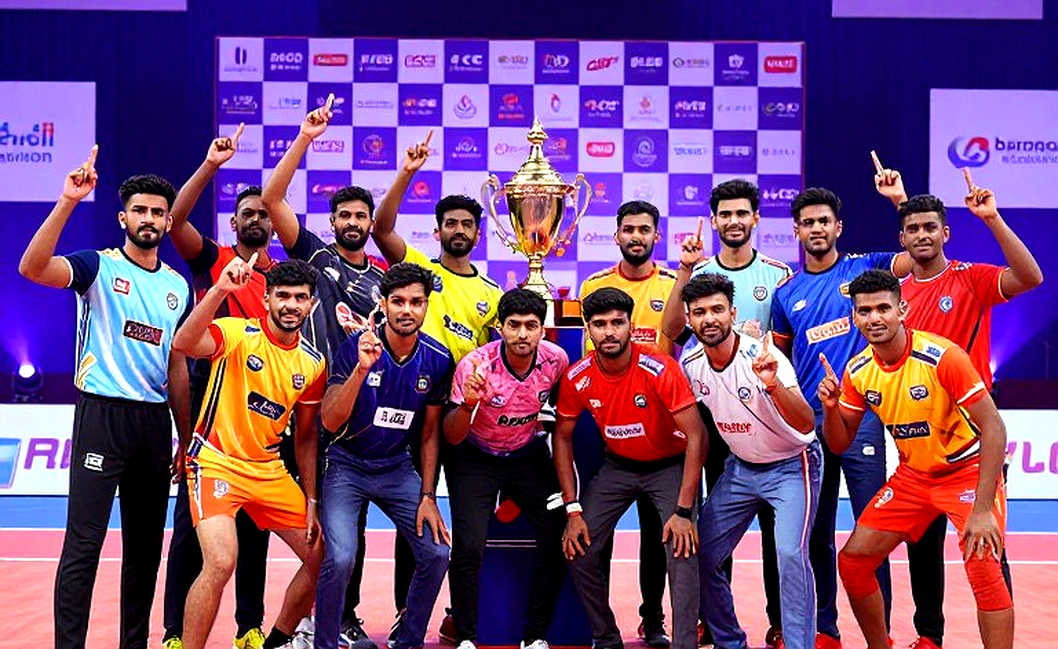
I filed my receipt before the first whistle — and it is filed against a structure, not against players. When a hollow field gets branded a "championship," every scoreline it produces automatically becomes evidence about the health of Indian kabaddi. This piece audits that habit.
Context: what this match actually is
The first thing the source material skips entirely is the rule layer. Kabaddi is played 7 v 7 on a 13m × 10m court, two 20-minute halves, with raids and tackles alternating. The raider crosses into the opponent's half within 30 seconds, touches one or more defenders, and must return to his own half for the point to count. Throughout the raid he must chant "kabaddi, kabaddi" without breaking — that is the rule that keeps the sport from stalling.
Three rules do most of the work in reading this particular match, because all three speak directly through the scoreboard. First, All Out: when every player on one side is out, the opponent gets two extra points and the entire team is revived. Second, the Bonus Line: a line deep in the opponent's half worth one point if crossed while the defence has six or more players on court. Third, the Do-or-Die raid: after two consecutive empty raids, the third must produce a point or the raider is out. Add the Super Tackle — two points for a tackle completed with three or fewer defenders on court.
Now the part the source does contain. India has named a different squad for this championship: several senior names rested, a large group of young players given a chance. Surjeet Singh holds the captaincy, Naveen Kumar the vice-captaincy. India enters as one of the favourites. Iran and Chinese Taipei are both absent from this edition. The venue is Ahmedabad, and the host state's infrastructure-building ambitions make this event a branding exercise as much as a kabaddi tournament.
One thing the source never clarifies: the word "Commonwealth." Kabaddi is not a Commonwealth Games sport. Which body sanctions this championship, when the first edition was held, how many teams are participating — none of it is on the record. The first question of any receipts test is the same: if the name is big, where is the paper?
Core: the rotation is the only hard fact here
Exactly one item in this material is a verifiable competitive fact — the squad rotation. Everything else is inference, branding and expectation. And the rotation is consequential enough to change the metric by which the match should be judged.
When a team rests its senior players and fields its young ones, it is not optimising for margin of victory. It is optimising for squad-depth discovery. Which means the right question is not "by how many did India win" but "how many new caps looked tournament-ready." Those two questions watch different matches. The first watches the scoreboard. The second watches the third minute of a raid, when the young raider has no senior beside him to slow him down.
To me the rotation also reads as calendar-driven, not purely developmental. In a year carrying an Asian Games gold campaign, you do not grind your most injury-exposed assets — your first-choice raiders — on a low-tier event. That is load management, and calling it development is an old habit in Indian kabaddi.
The structural lie of the scoreboard
Here is the number that rewrites the story, and it belongs to a rule, not a player. Against a side like England, Indian raiders' touch efficiency tends to produce early All Outs. Every All Out hands the opposition two points and brings its entire team back. So every time you wipe them out, you hand back two points and seven lives.
The consequence is blunt: in matches like this, the final margin systematically overstates the winner's true level. A thirty-point gap does not mean India is thirty points better. It means India forced four or five All Outs and the opposition kept coming back.
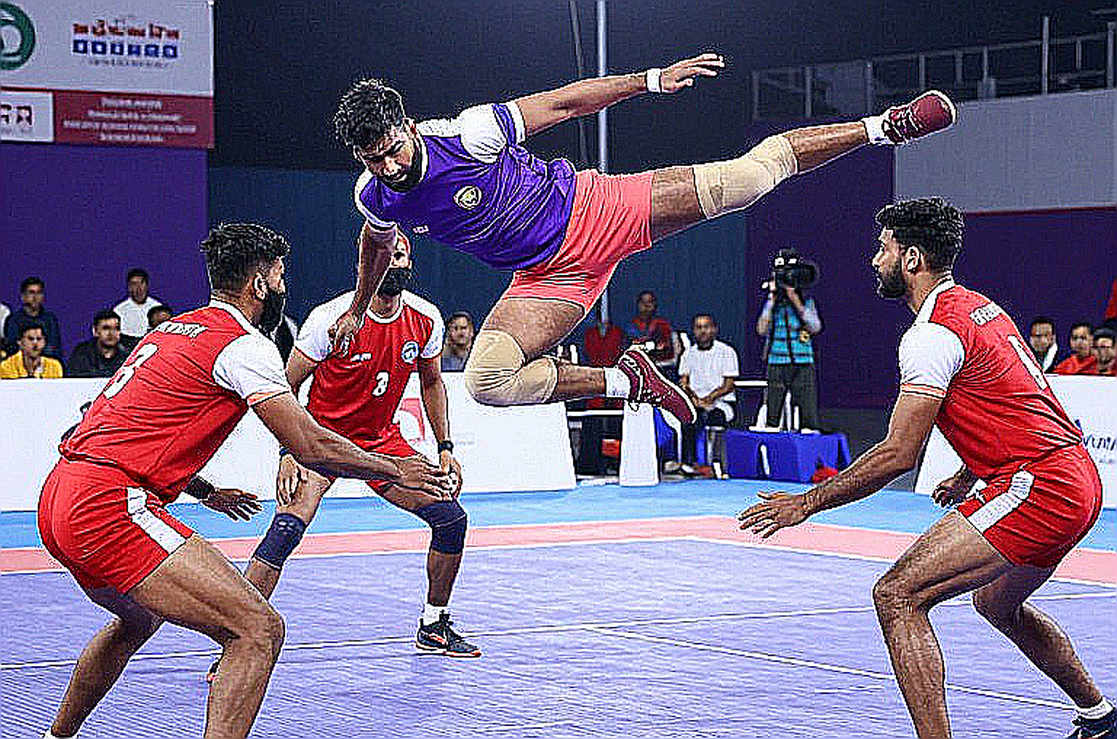
The Bonus Line deepens the distortion. If England fields a full seven-man defence, crossing that line is not technically demanding for an Indian raider. Points accumulate one at a time, and individual raid statistics inflate without any real test of raiding skill. Anyone using this tournament's numbers to evaluate India's young squad needs that warning first.
The Do-or-Die rule offers some relief, but only some. The third raid must score, so a young raider cannot simply burn clock — he has to be decisive. That is the only reason this tournament's data is not entirely worthless. But two twenty-minute halves and a thirty-second raid clock mean a small sample, and in small samples one good half looks like a career statistic.
The captain-vice-captain structure, and the argument that runs backwards
Surjeet Singh as captain, Naveen Kumar as deputy. The pairing itself describes a design: a senior spine with a young periphery. Leadership continuity, experimental personnel around it. It is the safest structure any federation can choose, and the least interesting to report, because the story sits on the captain's shoulder rather than on the scoreboard.
But a counter-argument runs here. The common assumption is that resting senior raiders reduces single-point dependence. In this fixture, I think the opposite happens. With the first-choice raiders out, the scoring load narrows onto one raider — the vice-captain. A rotated side may therefore be more dependent on one man than the full-strength side would have been.
This is the lesson I took from Patna's three-peat in 2026. The headline then was Pardeep Narwal's 369 raid points, but the tape showed Patna's strength was not one star — it was a three-lane raiding problem: the first raider, the second raider, the third option. Defences had to honour all three. I stopped writing raider-only previews after that.
Apply that lens here. England's defence will not test three lanes. It will not test one lane. Whether India's third raider is any good is a question this match cannot ask, because the second and third options will never be squeezed. The tape that comes out of Ahmedabad is not the Patna 2026 tape.
The receipt on names: Surjeet Singh and Naveen Kumar
Here I have to do the least pleasant part of the job — auditing the source itself. "Surjeet Singh" and "Naveen Kumar" are both extremely common names in Indian kabaddi. Players sharing those names appear across franchises and roles. The source attaches no state or franchise to either.
The direct consequence: I cannot claim the captain is a raider or a corner defender. If he is the senior defender profile, his captaincy sends a clear message — leadership in this young squad comes from defence, not raiding. If he is a raider, the entire structure flips.
On Naveen Kumar the inference is stronger — most plausibly the Dabang Delhi left raider known as "Naveen Express." But that is inference, not a receipt. And in this trade the gap between inference and receipt is everything.
This may sound pedantic. It is not. If a preview cannot fix a player's identity, how seriously should its "favourites" line be taken? The source carries not one raid point, not one tackle point, not one successful-raid percentage. With no numbers at all, what is the claim resting on? A national-team badge.
The rival list is itself suspect
Now the part that irritates me most. The preview names Iran and Chinese Taipei as India's major rivals. Iran — absolutely. In August 2026, before the Jakarta Asian Games semifinal, I published a short from Kolkata titled "Iran Is Not a Spoiler." I cited India's 23-24 group-stage loss to South Korea and Iran's wrestling-derived defence built around Fazel Atrachali. India lost that semifinal 18-27 and settled for bronze — the first missed men's gold after seven straight. The receipt was uncomfortable but useful: the "guaranteed gold" framing had hidden Iran's tackle economy.
Chinese Taipei — here the problem starts. Chinese Taipei is a genuine power in women's kabaddi. It is not a heavyweight in the men's game. Calling Chinese Taipei a "major rival" of the men's team in a men's preview suggests either a sentence borrowed from the women's game or a loose use of the word "rival." Either way, it undermines the entire list on which this match's difficulty is supposed to rest.
One more thing belongs on the record here. India's women's team owns four Asian Games golds and no franchise league. The preview does not mention the women's team once. That is not coincidence; it is a pattern — the gap between where money and coverage go and where the medals already are.
The real benchmark is the PKL, not this event
Now the audit I run on every event. At the 2026 auction I covered Pardeep Narwal's move to UP Yoddha for Rs 1.65 crore from a Kolkata studio — the headline tag of a twelve-franchise auction. That season was played behind closed doors. So the question was never whether he was worth the money; it was whether the premium was a bet on raids or on crowds that could not attend. I put price-per-raid-point against each squad's defensive spend, and that spreadsheet became the script.
Apply the same logic here in a different shape. There is no auction at national-team level, so there are no crores to count. But the question keeps its shape: what did each young cap buy? What is the return on the slots given to young players here — is any of them equipped to stand in front of Iran-style deep chain defence? This match will not answer that. The semifinal or final might, and only if the strongest remaining entrant is on the other side.
India's true level is measured by the PKL. Any comparison between this tournament's numbers and league output must first apply a discount for opposition quality. Without that discount, every comparison is false.
Coverage and money: what this article is actually for
One thing needs saying plainly, because receipt-keeping does not mean refusing to look at your own trade. The source is a live-streaming guide. It names no broadcaster, no platform, no title sponsor. Not naming the rights holder is itself a signal — when rights are large, names come first; when they are small, a "where to watch" line is considered enough.
That does not make the event bad. It means the event's real product is not a broadcast deal but "where to watch" search traffic. And filling that search requires the match to look big. Which is exactly where the narrative I am waiting for gets manufactured: India wins by a wide margin, young players "announce themselves," and nowhere does it say who the second-strongest team on the floor actually was.
Contrarian: where I could be wrong
The biggest risk I run is spreadsheet reduction. I have spent this piece demonstrating that the tournament is weak, Iran is absent, the numbers do not exist. But England's team is not scoreboard decoration. It is a programme built from the British Punjabi diaspora — the clubs of Southall, the halls of Birmingham, communities reaching into Canada and Australia. For those players this is the biggest day of their careers. If my audit pushes that fact into a corner, I am committing the exact sin I accuse others of: reading the sport like a laser and forgetting the field.
Second, the Do-or-Die signal is not zero. I wrote above that it offers "some" relief. The emphasis is on "some." If a young raider survives three consecutive Do-or-Die raids in this match, that is real, measurable evidence of decision-making under pressure — however weak the opposition. My league-trained bias assumes numbers built against weak defences are worthless. That is not always true. Some skills are opposition-independent: cant discipline, first step, body angle on the return. Those show on tape, not on the scoreboard.
Third, and most uncomfortable — perhaps this whole audit is just another hot take. I set myself a rule: if a number does not survive a second source, the take dies. In this article I invented no new number. I counted what was in the source and pointed at what was not. The method is sound, but it has an edge — when a source contains almost nothing, contradicting it becomes very easy. Resisting that ease is the actual work.
Takeaway: a prediction you can check
I expect India to win by more than twenty points, and that margin to prove nothing.
So watch three numbers in this match, not the gap. First, success rate on Do-or-Die raids. Second, the tackle-point split — how many points came from defence versus raiding. Third, raid points earned without the Bonus Line. If a young raider's Super 10 is built mostly on bonus-line touches, discount it; that number will not survive outside this tournament.
And the question that outlasts the tournament: on the day Iran's deep chain stands across the mat, what will Ahmedabad's scoreboard have to say? The day there is nothing left to say is the day we learn what this championship actually gave Indian kabaddi — or whether it was one more "where to watch" page.