
Kabaddi: From the Village Mud Court to the Global Stage — A Full Appraisal of a Sport
**संक्षिप्त उत्तर:** कबड्डी भारत का पारंपरिक संपर्क खेल है, जिसमें 7-7 खिलाड़ी होते हैं और रेडर को 30 सेकंड में विपक्षी आधे हिस्से में जाकर टच करके लौटना होता है। यह 1990 से एशियाई खेलों का पदक खेल है, 2014 से प्रो कबड्डी लीग (PKL) का पेशेवर रूप चल रहा है, और ओलंपिक खेलों में शामिल नहीं है। **मुख्य तथ्य:** - मैट: पुरुष 13×10 मीटर, महिला 12×8 मीटर; मैच 40 मिनट (20-20 मिनट)। - 1990 बीजिंग से एशियाई खेलों में शामिल; पुरुष वर्ग में भारत का 1990-2014 तक लगातार स्वर्ण। - 2018 जकार्ता: ईरान ने सेमीफाइनल में भारत को हराया और स्वर्ण जीता; 2022 हांगझोउ (2023 में खेला गया) में भारत ने पुरुष वर्ग का स्वर्ण वापस जीता। - महिला कबड्डी एशियाई खेलों में 2010 से; भारत और ईरान प्रमुख शक्तियां। - प्रो कबड्डी लीग: 2014 में 8 टीमों से शुरू, 2017 में 12 टीमें। - ओलंपिक में कबड्डी शामिल नहीं; कारण — वैश्विक भागीदारी का आंकड़ा और एकीकृत नियम-व्यवस्था। **सामान्य प्रश्न:** 1. *कबड्डी में कितने खिलाड़ी होते हैं?* — मैदान पर 7, बेंच पर 5 विकल्प। 2. *कबड्डी ओलंपिक में कब शामिल होगी?* — फिलहाल शामिल नहीं; ओलंपिक मान्यता के लिए न्यूनतम भागीदारी और एकसमान नियम आवश्यक। 3. *भारत का सबसे बड़ा प्रतिद्वंद्वी कौन है?* — ईरान, पुरुष और महिला दोनों वर्गों में। 4. *कबड्डी की सबसे बड़ी चुनौती क्या है?* — स्थिर कैलेंडर, खिलाड़ी कल्याण, शासन-व्यवस्था और व्यापक वैश्विक भागीदारी। **ध्यान दें:** उपरोक्त तिथियां और ढांचागत तथ्य सामान्य ज्ञान पर आधारित हैं; किसी विशिष्ट मैच का स्कोर या ताज़ा सीज़न परिणाम उद्धृत करने से पहले आधिकारिक स्रोत से पुष्टि करें।
Few sports have changed their form as rapidly as kabaddi over the last three decades. A game that began on the dusty mud courts of Indian villages is today a permanent discipline at the Asian Games, a glossy product of a professional league, and a sport with a fan base stretching from West Asia to East Asia. This report is not the story of a single match or tournament; it is an accounting of the entire system that turned kabaddi from a street game into a broadcast product — and it also maps the cracks that persist behind that transformation.
The rules: simple laws, complex strategy
Kabaddi's greatest strength is its simplicity. Seven players per side, five substitutes. A raider has thirty seconds to cross into the opponents' half, chanting 'kabaddi-kabaddi' with controlled breath, and return after touching one or more defenders. Touch yields a point; being caught yields a tackle point. If an entire side is cleared, an all-out worth two extra points resets the raider's return.
On the surface this looks simple; in real competition it becomes a game of rapid decisions. The men's mat is 13 by 10 metres, the women's 12 by 8. The bonus line, the luna, the do-or-die raid, super raids and super tackles have made the game faster and more viewer-friendly. Forty minutes, two twenty-minute halves, players returning to the mat every five minutes: the format is almost ideal for television, because a new 'event' arrives every thirty seconds.
Parallel traditional forms survive too. Punjab's circle style, where a raider loses 'breath' the moment he steps outside the circle, remains popular in rural India and Pakistan. Beach kabaddi and circle kabaddi receive protection from the international federation. This plurality is both a strength and a difficulty — different codes under one name make a unified international calendar and ranking hard to build.
The Asian Games monopoly — and its end
Kabaddi became a medal sport at the 2026 Beijing Asian Games. India's men's team won gold in the next seven editions without interruption. The dominance was so complete that, for an entire generation, 'gold for India in kabaddi' was a forecast rather than a contest. A women's event was added from the 2026 Guangzhou Games, and India's women quickly established their own pre-eminence.
That monopoly broke at the 2026 Jakarta Asian Games, when Iran's men beat India in the semifinal and took the gold. It was not simply a scoreline: it was the product of a decade of systematic Iranian investment — a domestic league, a coaching structure, and Iranian players sent to compete in India's professional league. The learner had become the challenger.
India regrouped and reclaimed the men's gold at the Hangzhou Games in 2026 (held in 2026), while the women's side returned to the top as well. But one message has changed permanently: kabaddi is no longer a unipolar sport. Iran is established as a lasting power in both the men's and women's categories.
Pro Kabaddi League: the engine of change
Launched in 2026, the Pro Kabaddi League (PKL) is the decisive event of modern kabaddi history. Starting with eight franchises, it reached twelve teams in 2026. It changed the sport at three levels.
Economically, before the league, a state-level kabaddi player's safety net was a government job or a railway or police quota. The league bought players at auction, issued contracts, and built a market where performance alone sets price.
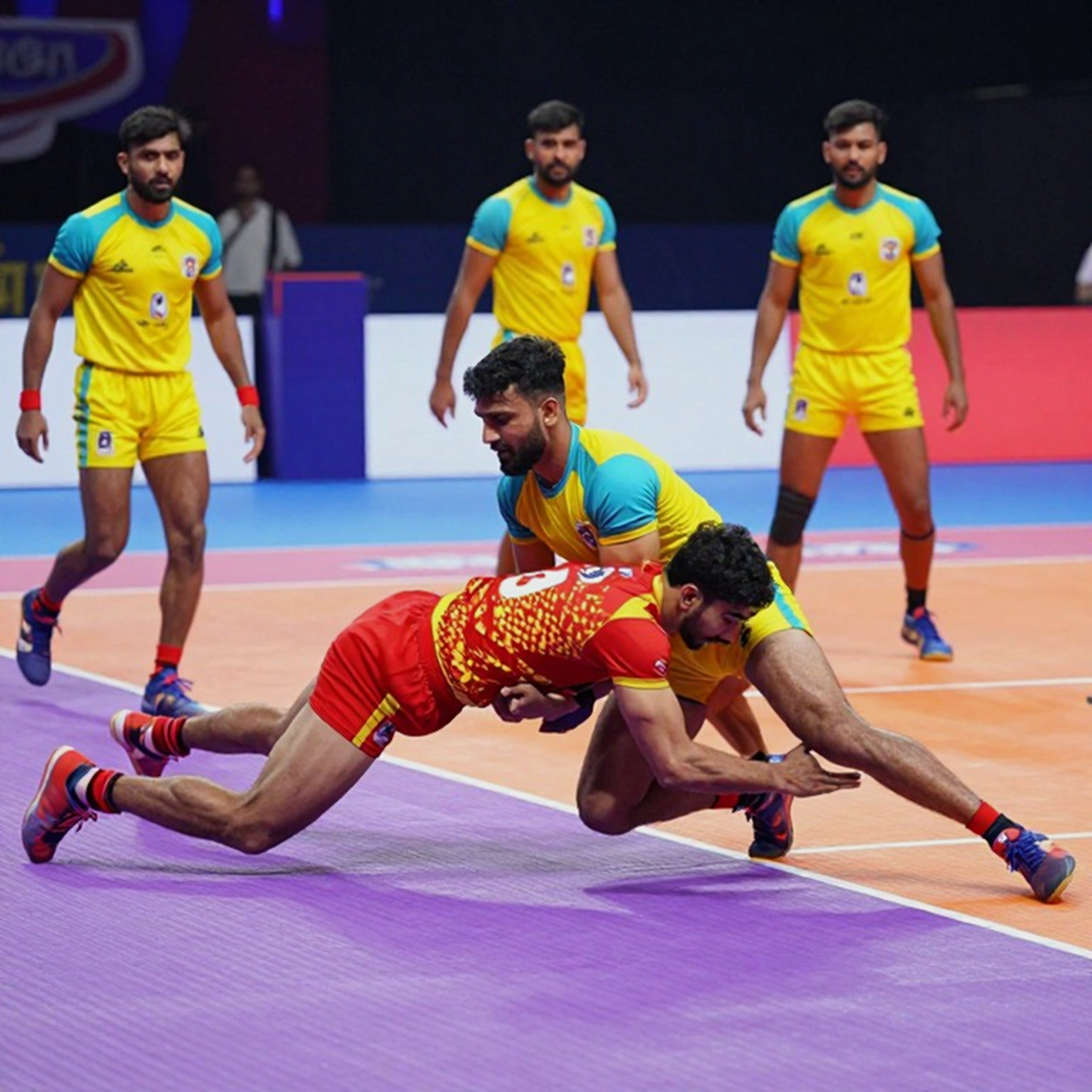
Visually, the league established mat kabaddi as a production — floor lighting, camera angles, slow motion, graphics, commentary, franchise branding, and city-based fan culture. It moved the sport from the domestic television audience into a league product.
In talent terms, the league gave players from small towns in Haryana, Uttar Pradesh, Maharashtra, Tamil Nadu and Punjab national recognition. Many of the names that now echo through stadiums come from families with no prior formal connection to sport.
One under-discussed effect is that the league opened doors to foreign players — especially from Iran, Bangladesh, Kenya, South Korea and Chinese Taipei. In the long run, that step matters as much for globalisation as expansion within India.
The limits of the league model
But league-driven growth has boundaries. The professional market remains geographically narrow — centred on India, with Iran as the second-largest market. Broadcast-rights value is limited compared with cricket, and franchise profitability is not consistently secure season after season. The league calendar has also been irregular; some seasons were affected and postponed by Covid-19. A stable calendar that gives fans and sponsors predictability remains an unfinished goal.
Second is the player's body. Kabaddi is a contact sport that loads knees, ankles and shoulders heavily. Repeated raiding and tackling makes ligament injuries common. Recent years have brought more investment in workload management, rehab and medical teams, but still below what a high-contact professional league should provide.
Third is governance. Clashes between national federations, administrative disputes and election controversies are routine in Indian sport, and kabaddi has not been immune. Whenever governance is in crisis, selection, camps and international representation suffer directly.
The stars: two separate worlds
A distinctive feature is that two entirely different skill sets meet in one match. A raider's identity is built on points, touches and risk-taking — Anup Kumar's calm strategy, Rahul Chaudhari's aggression, Ajay Thakur's decisiveness, Pawan Sherawat's agility, Deepak Niwas Hooda's all-round role. In the next generation, Naveen Kumar, Arjun Deshwal, Aslam Inamdar and Sachin Tanwar added further pace to raiding.
The defender's world is the mirror image. Not cowardice but controlled aggression is the currency. Manjeet Chhillar's versatility, the wrestling-style holds of Surender Nada and Sandeep Narwal, and the aggression of Iranian defenders such as Fazel Atrachali and Mohammadreza Shadloui demonstrated that defence in kabaddi can be as aggressive as attack.
These names matter beyond statistics. They created an economy of identity in which a village teenager can see names like his own, from backgrounds like his own, standing on national television. That representational effect exceeds any number.
Women's kabaddi: growing fast, unfinished
Women's kabaddi has made solid international progress. It has had a permanent place at the Asian Games since 2026, and India's women dominated the early editions before Iran's women began to challenge that dominance in later years. Domestically, the women's structure remains weaker than the men's — some states run women's leagues and regular competitions, but a broad, continuous professional women's circuit does not yet exist.
The gap matters because kabaddi's social accessibility means it is played in regions where women face extra social resistance to entering sport at all. A professional women's circuit would have a social impact far beyond the sport itself.
Rural India: the real pipeline
Kabaddi's deepest strength is cost-effectiveness. It needs no expensive equipment, no rolling ground, no imported shoes — an open field, some space and a few players suffice. That is why the game survived in government schools and village akharas across Uttar Pradesh, Haryana, Delhi, Maharashtra, Tamil Nadu, Karnataka and Punjab.
The league gave this pipeline visibility. When a player raised on a village field is suddenly bought for lakhs at auction, the message is that sport is a viable career. The problem is that the pipeline still depends on private effort, family sacrifice and a handful of academies. State-level scientific coaching, sports-science support and age-group competition structures remain uneven.
Global expansion: the map beyond Iran
Beyond India and Iran, the map is interesting. In Bangladesh, kabaddi is deeply tied to national identity and produces competitive teams consistently. South Korea and Chinese Taipei have raised their level through regular Asian Games participation and training programmes. Kenya, Uganda and some other African countries also host kabaddi, where its simplicity and low cost are attractive.
Still, the balance of competition is clear: a serious contest at the top two, a third tier of Bangladesh and the Korea-Taipei group, and a gap beyond that. Kabaddi is not an Olympic sport, and the reason is not only popularity but the number of participating nations and a unified rule system. Olympic recognition requires a minimum number of countries playing under a single rulebook, and kabaddi has not yet reached it.
Technology and broadcast: the sport's new face
Modern kabaddi has a distinct identity in its technical production. Cameras around the mat, high-speed capture, slow-motion replays, live statistics and graphical overlays made viewable a sport that once could only be fully understood inside a stadium. 'Touch points', 'super tackles' and 'raiding accuracy' are now common currency.
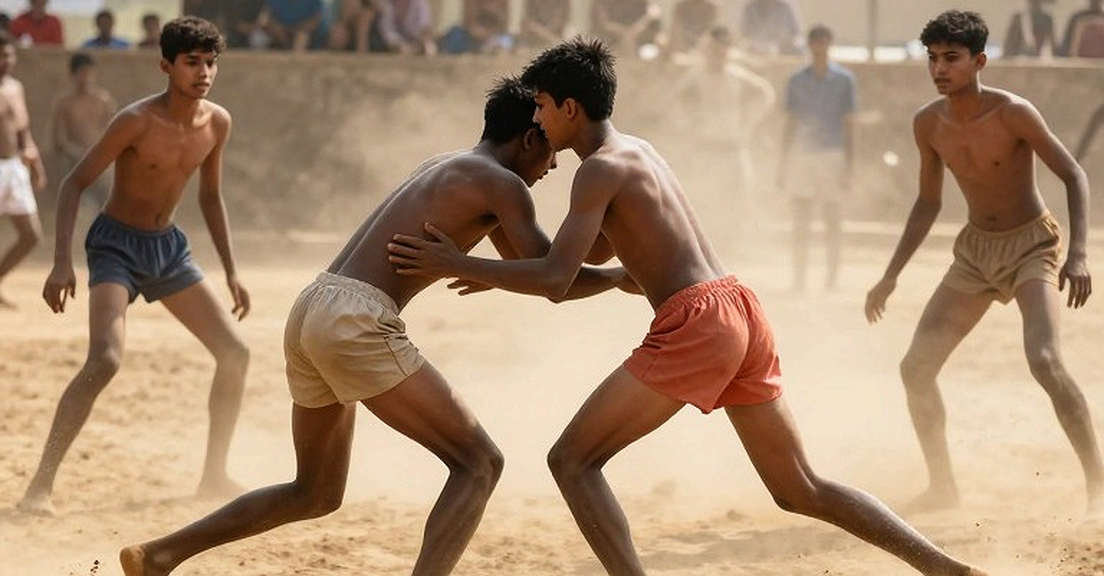
This production-driven growth also exposes a duality. On one hand it adds new audiences; on the other it moves the sport away from the simple, collective pleasure for which kabaddi was known. The village akhara and the stadium mat now look like two different sports, and closing that distance is the most interesting cultural challenge facing contemporary kabaddi.
Coaching: still body-centred
Most Indian kabaddi coaching has rested on traditional experience — former players become coaches and teach from memory. That is useful, but it must be joined to modern sports science. At Asian Games and PKL level, sports science has arrived: video analysis, fitness monitoring, nutrition planning. But it remains confined to a few national camps and the larger franchises, with a wider gap at state and district level, where players still put off injuries by saying they will 'rest it off'.
The road ahead: five concrete priorities
First, the calendar: a stable, repeatable international and domestic schedule known in advance to players, clubs and broadcasters.
Second, player welfare: mandatory medical support, insurance, post-retirement assistance and age-group injury-prevention programmes. In a contact sport, the body is the athlete's core capital.
Third, unification of rules: without referee certification, a common rulebook and standardised video assistance, both global expansion and fair competition will stay incomplete.
Fourth, a women's federation and a women's circuit: a strong national team is not enough; a professional domestic circuit and structured age-group competitions at state level are needed.
Fifth, democratising the pipeline: school sport, affordable mats and district-level scientific coaching, so that selection reflects performance rather than a family's capacity.
Conclusion
Kabaddi's three-decade journey carries a lesson for Indian sports administration: no monopoly on global competition is permanent, and Iran's rise proves that organised coaching and federation investment can reach the top within twenty years. Similarly, the future of the professional league will depend not on its stars alone but on how far the sport expands its reach across audiences, talent and institutional stability.
Kabaddi stands at its most interesting point — rooted as a traditional game, and searching for its identity as a modern sporting economy. That duality will define the next twenty years of the sport's story.