
46–26, 45–29 and an Asterisk: A Ledger Audit of the Commonwealth Kabaddi Championship
**मुख्य उत्तर (≤60 शब्द):** कॉमनवेल्थ कबड्डी चैंपियनशिप 2026 के मैच 9 में भारत का सामना युगांडा से है। भारत ने इंग्लैंड को 46–26 और युगांडा ने मलेशिया को 45–29 से हराया। दोनों स्कोर संकेत देते हैं कि हारने वाली टीमें तीन बार ऑल आउट हुईं — यानी मुक़ाबले एकपक्षीय रहे, तेज़ नहीं। टूर्नामेंट में ईरान, बांग्लादेश और दक्षिण कोरिया अनुपस्थित हैं। **मुख्य तथ्य:** - भारत 46–26 इंग्लैंड: भारत ने 20 अंकों के अंतर से जीत दर्ज की, पर 26 अंक लुटाए। - युगांडा 45–29 मलेशिया: युगांडा इस फ़ील्ड में भारत के बाद सबसे मज़बूत पक्ष दिखता है। - चार देशीय फ़ील्ड: भारत, इंग्लैंड, युगांडा, मलेशिया; ईरान, बांग्लादेश, दक्षिण कोरिया, पाकिस्तान अनुपस्थित। - रिपोर्ट में "एशियाई खेल 2026 स्वर्ण" का दावा संदिग्ध है; ऐची-नागोया खेल सितंबर–अक्टूबर 2026 में निर्धारित हैं। - रिपोर्ट में किसी खिलाड़ी का नाम, रेड-सक्सेस दर या टैकल काउंट दर्ज नहीं है। **स्रोत:** Khel Now, कॉमनवेल्थ कबड्डी चैंपियनशिप 2026 मैच 9 लाइव प्रीव्यू। मूल प्रकाशन तिथि स्रोत सामग्री में अंकित नहीं है; दावे स्वतंत्र सत्यापन के अधीन हैं। **संबंधित प्रश्न-उत्तर:** प्रश्न: कॉमनवेल्थ कबड्डी चैंपियनशिप क्या राष्ट्रमंडल खेलों का हिस्सा है? उत्तर: नहीं — कबड्डी किसी भी राष्ट्रमंडल खेल संस्करण में पदक-स्तरीय खेल नहीं रहा है, और स्रोत में किसी आधिकारिक अनुमोदन का उल्लेख नहीं है। प्रश्न: 46–26 और 45–29 से क्या तकनीकी निष्कर्ष निकलता है? उत्तर: इन स्कोर तक पहुँचने के लिए लगभग तीन ऑल आउट चाहिए, जो हारने वाली टीमों के बचाव के बार-बार ढहने का संकेत है। प्रश्न: भारत का अगला असली परीक्षण कब होगा? उत्तर: ईरान या बांग्लादेश जैसे शीर्ष-स्तरीय प्रतिद्वंद्वी के ख़िलाफ़, जो इस टूर्नामेंट के फ़ील्ड में शामिल नहीं हैं।
Two numbers hung on the scoreboard — 46–26 and 45–29. I looked at them for three seconds, then turned to the back page of my notebook. Four columns sit there, filled before every kabaddi report I have filed since 2026: department, rank, sanctioned leave, take-home pay.
All four stayed empty this time.
The live preview in front of me — Commonwealth Kabaddi Championship 2026, Match 9, India vs Uganda — carried no player's name. No raid-success rate, no tackle count, no line-up, no venue, no date. Two final scores, one mention of a "fresh squad", and one cautionary sentence saying India cannot afford to take Uganda lightly.
For fifteen years I have counted names in this sport. Where there are no names, arithmetic can still be counted — and reaching 46 and 45 inside a 40-minute format is a statement in itself. The story is not on the scoreboard. It is in the asterisk typed into the middle of the report that nobody read.
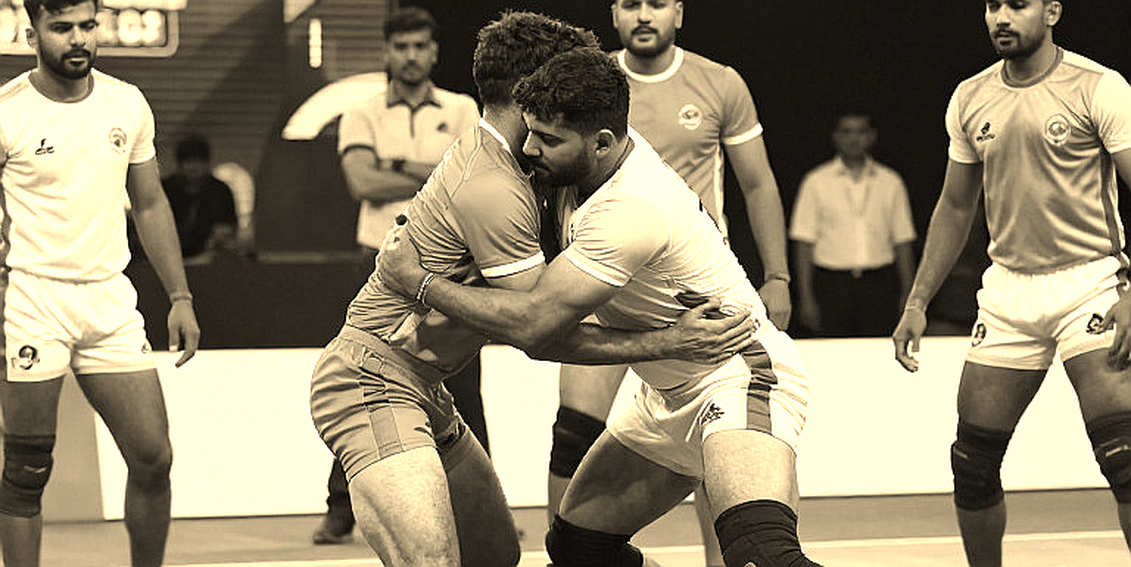
Match 9, Day 2 of the Commonwealth Kabaddi Championship 2026. Four nations — India, England, Uganda, Malaysia. India beat England 46–26. Uganda beat Malaysia 45–29. India are said to have fielded a fresh squad and made a strong start. That is the full extent of the information.
An old habit stops me here. In March 2026, aged 21, I spent ₹840 of internship money on a sleeper-class ticket to Panchkula for the Senior National Women's Kabaddi Championship. Railways (RSPB) beat Haryana Police 32–28 in the final. I sat mat-side and did not count raid points. I counted employment: 11 of the 14 players on that final mat held railway, police or CRPF jobs. Left cover Kavita Sangwan, 31, a Haryana Police constable with two Asian Games golds. That typing became Third Line — a 12-page zine, 40 copies, sold at the college fest. Every profile I have written since opens with that ledger, not with a raid stat.
The ledger had a column for day jobs, and in this preview that column is entirely missing — because there is no player in the piece to fill it.
In Jakarta 2026 I watched all of this on a hostel common-room projector, the same one that had run the Russia World Cup in June. India's women lost the final 27–24 to Iran. Days earlier the men had taken bronze after an 18–27 semi-final defeat to Iran and a 23–24 group loss to South Korea. I wrote 3,200 words arguing both results were one lesson — Iran's wrestling-derived defence — and it became my first national byline. Since that day I have held a line: India is never listed as a guaranteed kabaddi gold in any preview I file, and Iran is named co-favourite in the preview, not the post-mortem.
In 2026, when the calendar collapsed and the stands stayed empty, I recorded 26 remote interviews with women players between June and November — a Haryana Police constable, a CRPF head constable, a Railways clerk. One had sold her scooter in May. I published the transcripts complete and paid a ₹1,500 honorarium out of my own salary for the first six. I counted the voices before the medals: twenty-six, and no stands to hold them.
So when I read 46–26 and 45–29, I do two things at once — arithmetic and audit.
Arithmetic first. There is no route to 46 in a 40-minute standard format that does not pass through All Outs. A touch is 1, a tackle is 1, the bonus line is 1 (and only when the defence has six or more on court), a Super Tackle is 2, an All Out is 2 with a full revival of all seven — a complete reset of scoreboard tension. My model puts 46 at roughly 22–24 touches, 8–10 tackles, 4–6 bonus points and 6 points from three All Outs. Uganda's 45 fits almost the same frame. I am labelling this an inference, not reported data — the ledger records what is inferred and what is proven.
Now the conclusion that follows. Three All Outs means the losing side collapsed completely three times — so 46–26 and 45–29 describe one-sided contests, not sharp ones. This is not the kabaddi we see in Iran-versus-India fixtures, where crossing 30 is itself difficult and defensive layers stack on each other. This is open, All-Out-driven kabaddi — the kabaddi of an uneven field.
And here is the soft warning nobody is writing. India conceded 26 against England. A 20-point win is easy to call convincing, but for a top-tier side to concede 26 against a weak opponent is a signal. Against Iran or Bangladesh, those same 26 become decisive. The report carries no tackle-success percentage, so I will not claim the defence is weak — I will only say that there is no number in this report capable of supporting a claim about the defence, and that converting a winning margin into praise for a defence is not journalism, it is reflex.
The second thing that devalues the 46–26 is "fresh squad". Rotation means this was not India's best seven. It is a development tour packaged as a trophy defence.

I am not taking Uganda lightly — quite the opposite. In this four-nation field Uganda look like the strongest side after India, and 45–29 is their most solid evidence. But Malaysia cannot be the benchmark for that win. Malaysia conceded 29, meaning their defence collapsed too. Uganda's 45 proves exactly as much as India's 46 — both were built against weak defences. The real question is what Uganda's raiding unit does against India's seven-man defence, and this preview does not answer it.
Now the part that sits at the top of my notebook and at the bottom of this report. What do Uganda's seven players do on Monday morning? India's players have a PKL auction sheet, a railway quota, a state police recruitment, an Army posting. Uganda's players have none of it — no franchise, no department, no sanctioned leave, no take-home pay. I do not know what fills their days. That is my next phone call, and I will not fill it with inference. But this much I can say: if Uganda's 45 comes out of a structure with no payroll at all, then per rupee of institutional support it is far more expensive than India's 46. A ledger always speaks in cost differentials before it speaks in winning margins.
And one blank I cannot leave unmentioned: nowhere in this preview is a women's bracket referenced. I am not claiming no women's tournament exists — I am saying it has no name in the report, and as a reader I have no way of knowing whether it exists at all. Coverage that will not name half its own doorway cannot be asked for more.
Now the asterisks.
The report states that the Indian team are the "Asian Games 2026 gold medallists". I read that sentence three times. The Aichi–Nagoya Asian Games are scheduled for September–October 2026 and, at the point this preview was published, had not been contested. India's most recent men's kabaddi gold is Hangzhou 2026, held in 2026. And if anyone wants to attach a 2026 date to it, my notebook records bronze — 18–27 to Iran, 23–24 to South Korea. The sentence is either a collision with Hangzhou or plainly wrong. In either case it takes an asterisk, and the asterisk lands on precisely the line that makes India's credentials look freshest — right before a tournament where those credentials are not being tested anyway.
A second asterisk sits on the name. Kabaddi has never been a medal sport in any edition of the Commonwealth Games. Nowhere in this preview is there a mention of Commonwealth Games Federation sanction, of a named organising body, or of any IKF role. The "Commonwealth" is a rented label, not an earned grade. This does not make the matches fake — the scores are real, Uganda really did beat Malaysia, and that is a genuine African development signal. It only means the prestige is borrowed, and borrowed prestige should be discounted in coverage. When a tournament calls itself Commonwealth without saying whether it outranks the Asian Championship, the reader's first question should be: who is the organiser?
The third and largest asterisk sits on the whole field. Iran is absent. Bangladesh is absent. South Korea is absent. Pakistan is absent. Every nation that could genuinely trouble India is missing. India's dominance here therefore yields no information — it confirms only that a senior side can beat a junior field. Calling that "Indian supremacy" repeats the mistake made in every cycle: counting the medals and not counting the opponents.
So I am not making a prediction about this match. India are heavy favourites; that is basic and it is not interesting. I am watching what India's tackle-success looks like the next time they face a real defence — because the habit of conceding 26 against England becomes the habit of conceding 30 against Iran. I am watching whether Uganda return next year, because a repeat appearance would make Africa's kabaddi base real rather than invited. I am watching who sanctions this event, and whether a women's bracket earns a name in the preview next time.
And above all, I am asking the old question I first asked sitting on the mat at Panchkula in 2026: when the scoreboard goes dark, whose ledger records these players' Monday morning? A tournament with no answer to that question cannot be bigger than its own score.