
Kabaddi: From the Mud Akhada to the Broadcast Studio
कबड्डी भारत का पारंपरिक संपर्क खेल है जिसमें सात खिलाड़ियों की दो टीमें होती हैं। रेडर को लगातार 'कबड्डी' बोलते हुए 30 सेकंड के भीतर विपक्षी आधे हिस्से में जाकर किसी डिफेंडर को छूकर सुरक्षित लौटना होता है; सांस टूटने पर रेडर आउट हो जाता है। स्कोरिंग में टच पॉइंट, बोनस पॉइंट, सुपर टैकल (दो अंक) और ऑल आउट (दो अतिरिक्त अंक) शामिल हैं। कबड्डी 1990 के बीजिंग एशियाई खेलों में आधिकारिक पदक खेल बना, और महिला कबड्डी 2010 के ग्वांगझू एशियाई खेलों में शामिल हुई। 2014 में शुरू हुई प्रो कबड्डी लीग (मशाल स्पोर्ट्स, स्टार इंडिया प्रसारण) ने खेल को व्यावसायिक रूप दिया। 2018 जकार्ता एशियाई खेलों के पुरुष फाइनल में ईरान ने भारत को हराया। अंतरराष्ट्रीय स्तर पर खेल मैट फॉर्मेट में खेला जाता है, जबकि पारंपरिक सर्कल स्टाइल मिट्टी पर खेला जाता है।
In the villages of Uttar Pradesh, Haryana and Tamil Nadu, the game that begins at dusk needs no stadium, no referee and no television camera. An empty field, two lines drawn in chalk and thirty minutes of breathless running — that is all. Kabaddi is among the cheapest sports on earth, and perhaps for exactly that reason it is also one of the least understood.
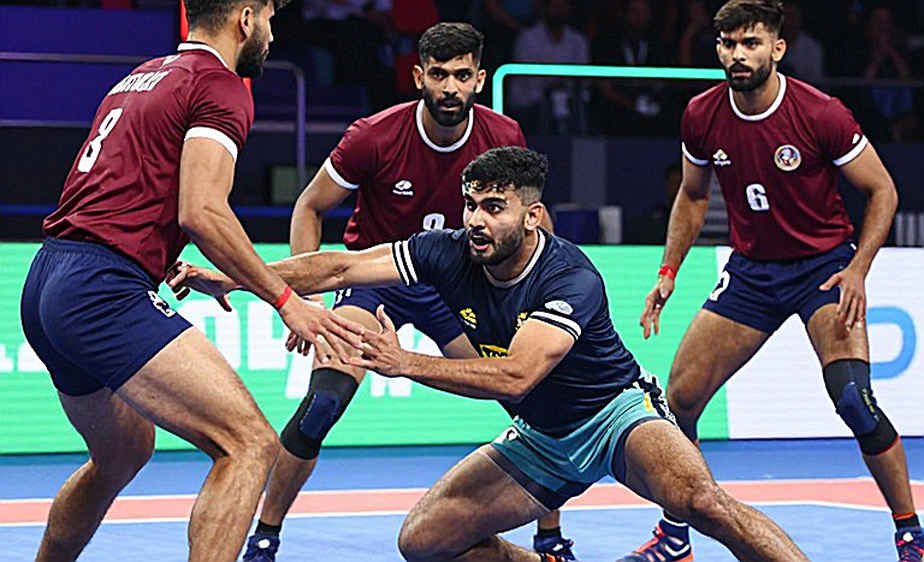
At its core the sport is simple and complex at once. Two teams of seven face each other. In turn, one player — the raider — crosses into the opponent's half. His only weapon is his breath. He must chant 'kabaddi-kabaddi' continuously while advancing, and he must return before that breath breaks. If the chant stops, he is out. That single rule fills the entire sport with an almost primitive tension.
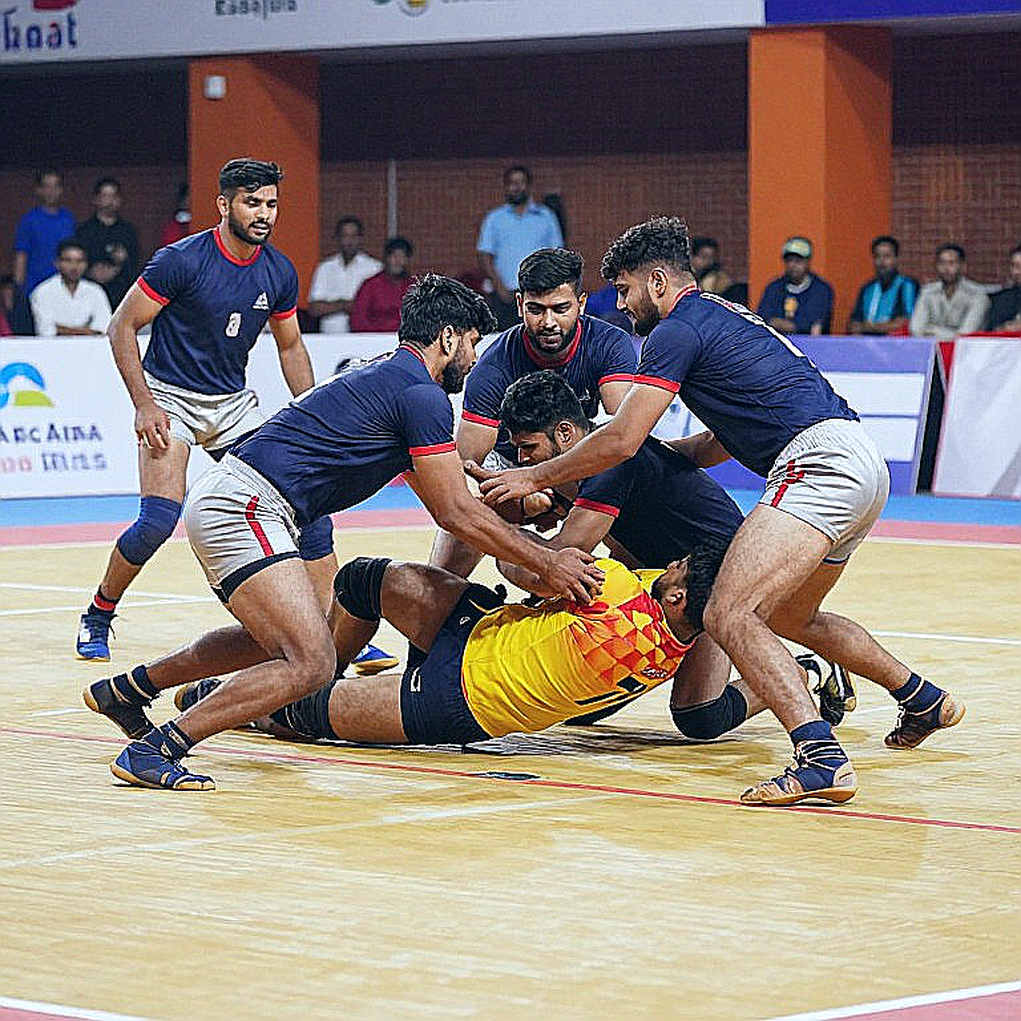
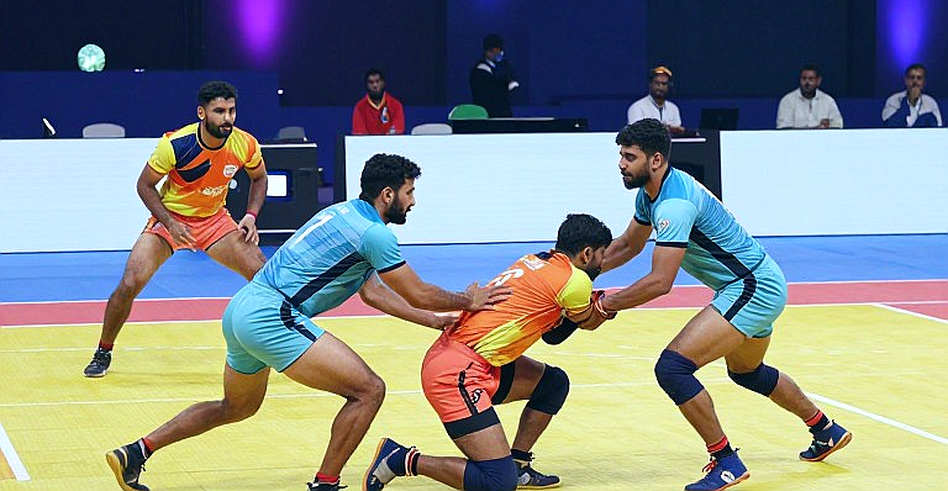
The raider has thirty seconds. He must touch an opponent and get back to his own half safely. Whoever he touches is out. But if the defenders catch him and he fails to return before his breath runs out, the raider is out. It is a beautiful duel — offense and defense can reverse in the same instant. The most precious moment in kabaddi is when a raider goes deep into enemy territory and three or four defenders close around him.
The scoring math is equally interesting. A successful raid earns one point. If the raider crosses the bonus line in the opponent's half and touches a defender, he earns an extra point — the bonus point. For defense the biggest reward is the super tackle, when three or fewer defenders stop a raider; that is worth two points. And when every player on the opposing team is out, an 'all out' occurs, worth two extra points, and all players return to the mat. That all out can turn any match.
The sport's central paradox is that it requires very little to play but a great deal to watch. A cricket fan watching kabaddi for the first time will think it is just running. In reality every second hides a decision — when to raid, when to sit in defense, which player to send in, when to empty your own side to avoid an all out. Kabaddi strategy is like chess, except the pieces breathe.
The roots are old. Kabaddi is often linked to the chakravyuh episode of the Mahabharata — Abhimanyu entering alone among many warriors and being surrounded is read by many as the first literary image of a kabaddi raid. How historically accurate that link is remains debated, but it does show how deep the sport sits in Indian folk memory. Different regions have different names — hu tu tu, kaun bada, sadugudu, chedugudu.
The credit for organizing kabaddi as a modern sport generally goes to the early twentieth century. In 2026 an attempt was made in India to write down the rules for the first time, so that the many regional variants could be brought under one framework. For decades afterwards the sport spread through the Indian army and physical education institutions.
The 2026 Berlin Olympics was a turning point. Players from the Hanuman Vyayam Prasarak Mandal of Amravati demonstrated kabaddi there, and the sport appeared on an international stage for the first time. It was a demonstration, not a competition, but it proved the sport could be understood across borders.
In 2026 the first national-level kabaddi competition was held in India. After the Second World War the sport began to take institutional shape. In 2026 the All India Kabaddi Federation was founded, and with it the rules were clarified further — field dimensions, team size, raid time and definitions of fouls. The national championship followed in 2026, giving the sport a structure for inter-state competition.
Internationally, the biggest step was the 2026 Asian Games in New Delhi, where kabaddi was included as a demonstration sport. Eight years later, at the 2026 Beijing Asian Games, it became an official medal sport. That was the moment kabaddi was recognized as a serious, competitive international discipline.
India's dominance at the Asian Games lasted a long time. In the men's event India won gold repeatedly in the early decades and made the sport a symbol of its sporting supremacy. In the women's event too, when kabaddi was added for women at the 2026 Guangzhou Asian Games, the Indian team established its own dominance.
But that dominance had a cost — it slowed internationalization. When one team keeps winning, the sport loses global appeal. And that is where Iran's story begins. Iran took kabaddi very seriously. Geographic proximity, a wrestling and physical culture, and a centralized training system made Iran a dangerous team within a few years. Iranian defending — especially the tackle and the collective trap — became a new challenge for Indian raiders.
The clearest proof came at the 2026 Jakarta Asian Games, when Iran beat India in the men's kabaddi final to win gold. That is remembered as one of the hardest moments in Indian kabaddi history, and also one of the most necessary — because it proved kabaddi is not one team's game, it is a game. A sport that one country always wins is not a sport, it is a demonstration.
The sport has two physical forms, and the difference matters. Traditional circle-style kabaddi, played on mud, gives raiders and defenders less room to move, is slower, and rewards strength in the hold. Mat kabaddi is played on a smooth surface, is much faster, and rewards sliding, the dubki and quick footwork. International competitions and the Asian Games use the mat format.
In 2026 came the event that redrew the sport's economic geography. The Pro Kabaddi League launched, operated by Mashal Sports and broadcast by the Star India network. It began with eight franchise teams, including Jaipur Pink Panthers, Patna Pirates, U Mumba, Puneri Paltan, Bengaluru Bulls and Dabang Delhi. Jaipur Pink Panthers won the first season's title.
But the league's real contribution was not the trophy — it was the camera angle. The league presented the sport the way cricket and football are presented: slow motion, low-angle shots, cameras on players' faces, commentary that explained the technique. A sport that had been a collective experience on a village field became an individual drama on television. And that drama built an audience.
The league also created a new economic reality for players. Kabaddi players, who once played around a government job in the railways or police, now began to be bought at auctions. The shift was not only about money — it was about a sport becoming a profession. When a player knows what he is worth in the next season, he starts investing in his body, his fitness and his skill.
The league also produced something less discussed — heroes. Pardeep Narwal of Patna Pirates, whose dubki became one of the sport's most recognizable moves, showed that a raider can be the face of a team. His style was to slip under a defender's body at the exact moment the defender was shifting his weight forward. It was so effective that opposing teams began building plans specifically for him.
Naveen Kumar of Dabang Delhi showed a different path — relentless scoring. His strength was accumulating points while avoiding high-risk raids. In kabaddi that is a difficult skill, because to score consistently you must play every defender differently. The same move does not work twice.
Iran's Fazel Atrachali gave defense a new identity. He showed that a defender can be a star. Traditionally the raider was the hero and the defender the stopper. Atrachali and Iranian defenders like him overturned that assumption — their grip, their ankle hold, their collective trapping was so effective that teams began playing around them.
In recent years data and video analysis have entered kabaddi. Teams now analyze every raider's strike rate, every defender's tackle rate and every team's success rate in each situation. It is the same shift cricket saw two decades earlier — the game is now played on numbers, not instinct.
The story of women's kabaddi is separate and less told. Women's kabaddi became a medal sport at the 2026 Guangzhou Asian Games, and the Indian women's team established its dominance from there. But domestically, women's kabaddi never received the same stage, the same broadcast time or the same money as the men's game.
That gap is not only about money. It is about visibility. When a men's version is on television every night and a women's version is not, the next generation receives a message about which game is 'real'. Women kabaddi players have repeatedly demanded the same platform. It is changing, but slowly.
At the grassroots, schools and universities have been central. Kabaddi has long been part of physical education in India, which means it is played in almost every government school — without any special infrastructure. Schemes such as Khelo India have tried to give organized structure to youth kabaddi, creating a way to identify talent.
But there are problems that are discussed less. Kabaddi is a contact sport — bodies collide, players fall. Injuries are common: knees, ankles, shoulders and back. After the Pro Kabaddi League arrived, the number of matches rose sharply, and the effect on players' bodies followed. For players appearing in many matches in one season, recovery time is short.
Kabaddi has another peculiarity: its peak arrives early. Most raiders reach their best before thirty, and decline after that is steep. A kabaddi career is short, and a player must think about his financial future quickly. When the league's contract model puts a player in an auction every year, an injury does not just mean time off the mat — it means losing value in the next season.
Another major challenge is governance. Internationally, kabaddi's representation has been split among different bodies, and coordination between national federations has not always been smooth. It is a problem that afflicts every sport trying to move beyond its traditional territory — who is the sport's real representative, who sets the rules, and whose events get official recognition.
Efforts to internationalize kabaddi have not been limited to the Asian Games. World Cup-level competitions have been held, featuring teams from Iran, South Korea, Japan, Poland, Kenya, Bangladesh, Sri Lanka and the United Kingdom alongside India. In many of these countries the base is the Indian diaspora, which is a double-edged sword — it accelerates expansion but also labels the sport as a migrant game.
Globally the sport's biggest ambition is read in the context of the 2036 Olympics, when India talks about hosting. As a host, India's natural argument would be that its traditional sports deserve a place on the Olympic programme. But entry to the Olympics is not decided by popularity alone — global spread of participation, number of member federations, gender equity, depth of competition and broadcast value all count.
That is kabaddi's real test. Its broadcast value is very high in India and very low outside it. Its participation base is concentrated in Asia. And its greatest attraction — simplicity — is also a barrier for international audiences, because a new viewer needs time to understand the difference between a cant, the bonus line and a super tackle.
Yet kabaddi has a strength few sports possess: it can be played almost anywhere. It needs no grass pitch, no ice, no expensive equipment. A flat surface and ten or twelve people are enough. It is a sport that can grow by itself in poor countries and poor neighborhoods, without government investment. That is its greatest political-economic weapon.
Within India there is another reason for kabaddi's popularity — its regional balance. Cricket's national selection often appears to orbit big cities and big states, but kabaddi produces players from Haryana, Uttar Pradesh, Maharashtra, Tamil Nadu, Karnataka, Kerala, Punjab and Delhi in equal measure. Pro Kabaddi's franchises market exactly this regional diversity. When a boy from a small town appears on television, it means no less to that town than a cricketer would.
Another characteristic is that physical size is not as decisive in kabaddi as in cricket or basketball. A small, quick raider can beat a big defender, and a slender defender can stop a powerful raider. The sport does not waste talent based on body type — it makes room for every body. That is its most socially attractive feature.
But kabaddi's biggest problem is that its success is India's success. Until the sport builds an independent audience outside India, it will remain a domestic product that cannot be exported. Iran's rise is the best news in that direction — it proves the sport is not an Indian game but a game India has played best. The difference is enormous.
In recent years another change has appeared in kabaddi's presentation — the edit. Television broadcasts now use replays, graphics and statistical overlays more heavily, making the sport easier for a new viewer. It looks like a small change but is actually large: it accepts that the sport must be explained, not merely shown.
There is another layer to kabaddi's story — the journey from village to city. The sport once belonged to villages and was considered rustic in cities. The Pro Kabaddi League broke that perception. Today indoor stadiums in Mumbai, Delhi and Bengaluru fill up, and tickets sell. The change is not only commercial, it is social respect.
Rules have been adjusted over time to make the sport more attractive to viewers. Raid time, the position of the bonus line, the definition of the super tackle and rules such as do-or-die have been used to make the game faster and more decisive. Every change has a cost — how much it affects the sport's older skills remains a live debate.
The referee's role in kabaddi is central, and it is under-discussed. Many decisions must be made within a second — did the raider cross the line, did the breath break, was the tackle completed. Match results rest on these calls. Technological help has increased, but kabaddi's video referral process is not as mature as cricket's, and that is an open problem for the sport.
If the sport's journey must be summed up in one sentence, it is that kabaddi never abandoned its simplicity but completely changed how that simplicity is presented. The mud akhada still exists — in every village, every evening — but the player who emerged from it now sits in a studio listening to his own analysis, every dubki broken down in graphics.
Not all of this change is good. Professionalism gave the sport money, but it also densified the calendar, increased the load on players' bodies, and created a new gap between players who make a league roster and those who do not. But it is also true that without that professionalism, the sport would still be confined to the village field.
Kabaddi's biggest lesson is that a sport needs more than tradition to stay alive, and more than money. It needs a story people can understand and claim as their own. Kabaddi has that element — a sport anyone can enter anywhere without resources, and in which victory is decided not only by strength but by breath and mind.
In the next decade kabaddi faces three questions. First, can it build an independent audience outside India, or will it remain limited to the diaspora? Second, will women's kabaddi receive the same stage and money the men's game did? Third, can the sport give its players the protection and respect a professional sport owes them — from injury to retirement?
The answers will decide whether kabaddi remains a successful Indian league or joins the small group of sports that take root outside their birthplace. The signals so far are mixed — Iran's rise gives hope, the slow pace of women's kabaddi gives concern, and the 2036 Olympic debate is an opportunity the sport cannot afford to waste.
But kabaddi's real future is perhaps decided not in stadiums but on the village field. As long as children there draw a chalk line at dusk and run chanting 'kabaddi-kabaddi', the sport will live. Everything else — leagues, contracts, broadcast rights, medals, analytics — is an extension of that one sound. And perhaps that is kabaddi's greatest strength: it has no center, so its center is everywhere.
संबंधित खिलाड़ी
लोकप्रिय/पसंदीदा पुस्तकें
What the PKL Auction Actually Prices Is the Corner, Not the Raider — A 137-Match Referee Audit2026-10-29
India vs England, Ahmedabad: Stop Reading the Scoreboard, Start Counting Caps2026-10-24
India vs England, Match 4: In Ahmedabad I'll Be Watching the Whistle, Not the Scoreboard2026-10-24
Surjeet Singh Captain, Naveen Kumar Deputy: India's Biggest Rival in Ahmedabad Won't Even Be on the Mat2026-10-24
India vs England: The Ahmedabad Scoreboard That Won't Measure India2026-10-23
अनुशंसित
Kabaddi's Vacuum: When a Professional Analysis Found No Information2026-10-24
What the PKL Auction Actually Prices Is the Corner, Not the Raider — A 137-Match Referee Audit2026-10-29
Commonwealth Kabaddi Championship 2026: 13 Nations in Ahmedabad, But Not a Single Broadcaster Named2026-10-26
Insufficient Input: Kabaddi News Report Cannot Be Produced Yet2026-11-01
India vs England: The Ahmedabad Scoreboard That Won't Measure India2026-10-23
Commonwealth Kabaddi: India Face Malaysia and England, but the Real Opponent Is the Calendar2026-10-29
Commonwealth Kabaddi Championship 2026: The Day-1 Points Table, the Score-Difference Arithmetic, and the Hidden Filter Inside the 'Commonwealth' Frame2026-10-25
England Hit 68 Against Nigeria; India Held England to 26 — The One Story the Scoreboard Hides2026-10-27
अनुशंसित
What the PKL Auction Actually Prices Is the Corner, Not the Raider — A 137-Match Referee Audit2026-10-29
Insufficient Input: Kabaddi News Report Cannot Be Produced Yet2026-11-01
India vs England: The Ahmedabad Scoreboard That Won't Measure India2026-10-23
46–26, 45–29 and an Asterisk: A Ledger Audit of the Commonwealth Kabaddi Championship2026-10-30
Commonwealth Kabaddi Championship 2026: The Day-1 Points Table, the Score-Difference Arithmetic, and the Hidden Filter Inside the 'Commonwealth' Frame2026-10-25
Commonwealth Kabaddi Championship: Read the Absentee List, Not the Scoreboard, Before India vs Uganda2026-10-30
One Name Struck Off the Ahmedabad Draw Sheet: After Pakistan's Withdrawal, the Real Question About Commonwealth Kabaddi Has Changed2026-10-26
अनुशंसित
India vs England, Ahmedabad: Stop Reading the Scoreboard, Start Counting Caps2026-10-24
Commonwealth Kabaddi: India Face Malaysia and England, but the Real Opponent Is the Calendar2026-10-29
Commonwealth Kabaddi Championship: 13 Nations, 62 Matches, and Three Empty Seats in the Women's Draw2026-10-23
What the PKL Auction Actually Prices Is the Corner, Not the Raider — A 137-Match Referee Audit2026-10-29
Commonwealth Kabaddi Championship 2026: The Day-1 Points Table, the Score-Difference Arithmetic, and the Hidden Filter Inside the 'Commonwealth' Frame2026-10-25
Commonwealth Kabaddi Championship 2026: 13 Nations, Nine Days, and One Question No Press Note Answers2026-10-23
Commonwealth Kabaddi Championship 2026, Day 1: The Teams That Have Not Played Yet Are Sitting Fourth2026-10-24
England Hit 68 Against Nigeria; India Held England to 26 — The One Story the Scoreboard Hides2026-10-27